
Splats break apart by parts: champions, a C++ core, and what Next Fest told me about the tech
In October I wrote about how Gaussian splats became destructible hulls in AsterMaster, a rhythm roguelite on a hex grid built in Godot 4.6: a hull is not a mesh but a cloud of a few thousand Gaussians that can be dented, pierced and torn into chunks. That post was about how to make a splat and draw it. This one is about what happens to it in a fight, and what that costs.
- Steam: store.steampowered.com/app/5095060 — free demo, release in January 2027.
- Site: aster-master.com — trailer and a bestiary built on the same splats.
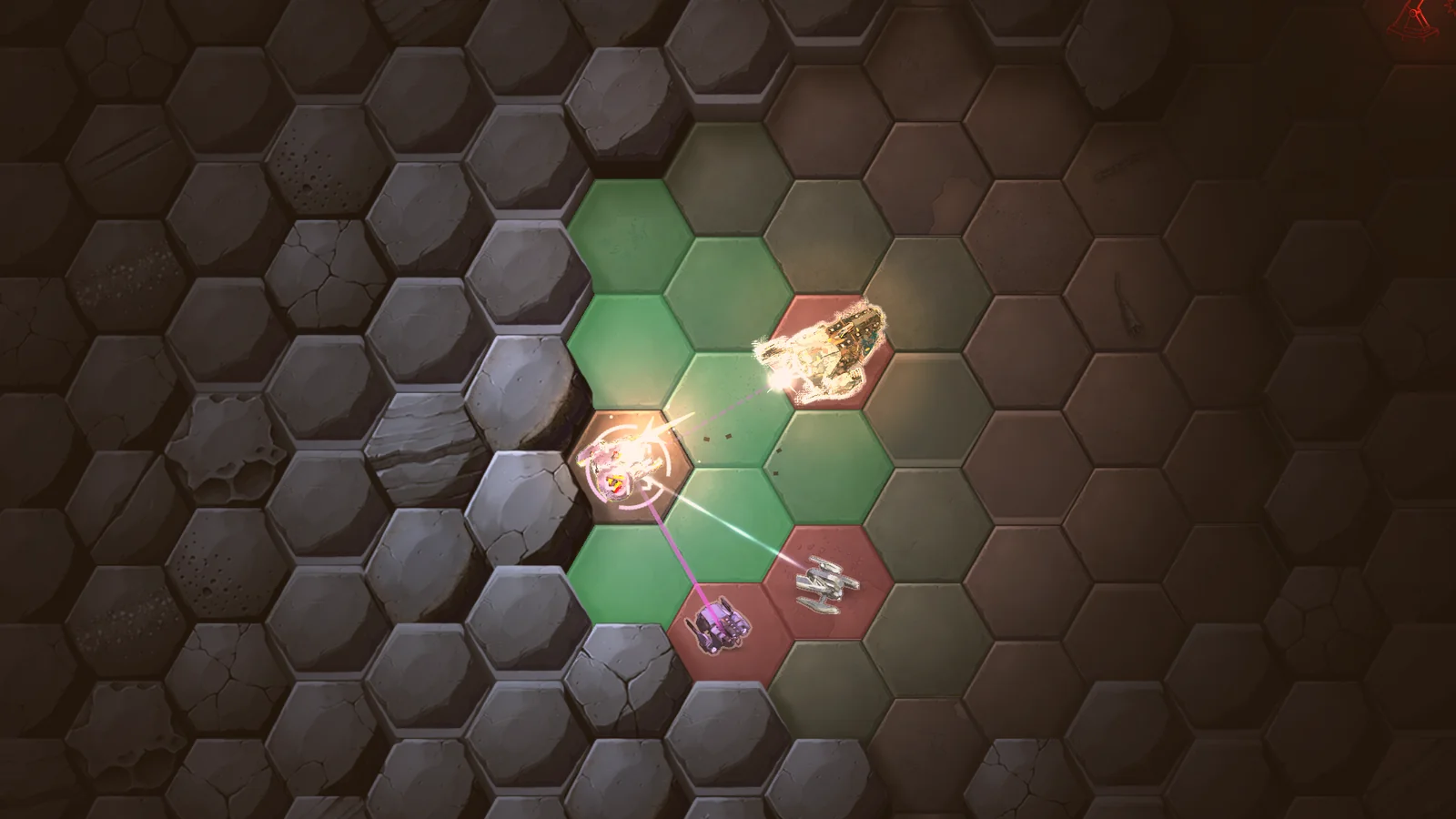
First, a correction to the previous post. It had a section called “Regular mobs went back to meshes”: at 60–90 pixels splat destruction doesn't read and doesn't pay for itself. That is still true — for regular mobs. But since then splats have come back, first for the larger turrets and then for seven special enemies, the pack leaders. The game calls them champions, and for them destruction is no longer an effect but a rule of combat: whichever part of the hull came off, that ability is gone.
In order: how champions are built and what they cost per frame; why the part that breaks off is chosen by the weapon and not by the aim; what changed for bosses; how the destruction core moved from GDScript to C++ and how I verified it computes the same thing bit for bit; what didn't work; and what Steam Next Fest gave me — with numbers, including the unpleasant ones.
A note on measurements: every number here was taken on a Mac M1, my development machine. The game ships on Windows, and I check the Windows build under Wine — a self-test and a few runs. I have no measurements on real Windows hardware yet, and I won't pretend otherwise.
Champions: a splat enemy in a crowd
A champion is the leader of a pack of ordinary enemies: 1.25 times larger than its escort, while the escort has half the health. There are seven kinds. Three champions with a pack show up in a run — one per segment; besides them you meet smaller champions along the way — loners without a pack.
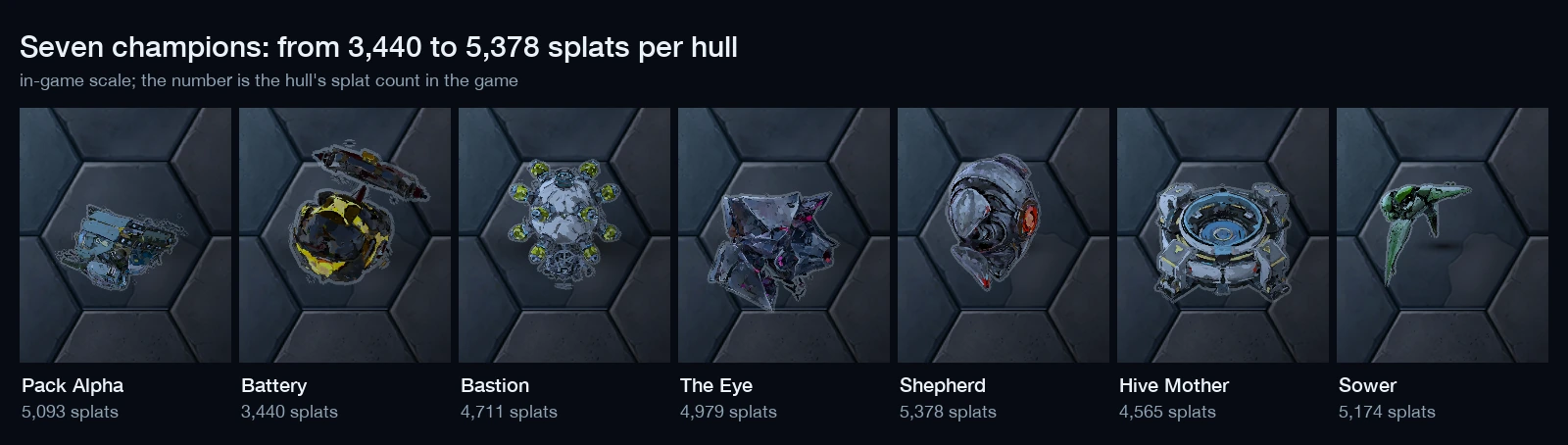
I still train to a budget of 6,000 Gaussians, but only the opaque core goes into the game — from 3,440 to 5,378 splats per hull. The Battery needed the cloud of splats around its rotor cut away; 3,440 of 5,184 were left after cleaning.
What it costs
Measured on November 5–6, M1, 1080p, not re-measured since:
- one champion hull is about 1 ms of frame time, or 0.16 ms per thousand splats;
- a pack of three versus a single champion is roughly +2.4 ms on the median frame and +9 ms on p95, with p95 noise of ±5 ms.
Hence a hard rule: no more than three splat hulls in a room. A pack is one or two enemies in the first segment, two in the second, two or three in the third.
The most expensive thing turned out to be not the hull but the light. The Shepherd carries its own light source, and at radius 3.6 that single light added 8 ms to p95. I kept radius 3.0.
How a hull is split into parts
In the first post bosses already had “chunks” — groups of about a hundred splats that fly off together. Champions needed one level above that: a part of the hull that means something — nose, stern, dome. The whole split is computed at export time; the game only reads it.
1. The source mesh is decomposed into face islands — connected components. An island is never cut, so a part is rigid: a plate of plating never ends up half in the nose and half in the stern.
2. The islands are grouped into eight parts by weighted k-means over their centroids, weighted by area. The start has no randomness: the first seed is the largest island, each next one maximizes area times squared distance to the nearest seed. Then up to 50 iterations.
3. A splat inherits the part of the island whose triangle it was born on.
4. Chunks are cut inside a part and a material. A chunk never crosses a part boundary — otherwise tearing off the nose would take a scrap of the side with it.
Parts come out unequal: on the Pack Alpha from 368 to 838 splats, and the Battery's smallest part is 21 splats. The Hive Mother is the exception: it has three hand-labelled parts (base, ring, turbine), because k-means doesn't know the ring is a separate piece.
At runtime a part only needs the centroid of its living splats. A part's role — nose, stern, top — comes from the angle between the direction to that centroid and the nose axis or the vertical. The direction is captured once, on the intact hull, so a role doesn't drift as the part loses splats.
The first Pack Alpha was a smear
The very first attempt to put the Pack Alpha on splats was back in the summer: about 2,800 Gaussians and 128² source textures. Next to the crisp meshes of the other enemies it looked like a blurry blob. In November I retrained it at the full budget.
Training no longer happens at home: my machine is a Mac now, with no CUDA. A rented Tesla T4 does one run in 50 seconds. A cheaper card, a GTX 1080, didn't work at all: gsplat's kernels with the MCMC strategy need compute capability 7.0 or higher, and the Pascal generation is 6.1.
Who shows up in a run
The pools of pack champions per segment don't overlap: Pack Alpha or Sower in the first, Battery, The Eye or Shepherd in the second, Bastion or Hive Mother in the third. The pick is made by a separate generator seeded from the run seed. The game's shared generator is not advanced — otherwise the Daily Challenge, where every player gets the same seed, would have shifted just because new enemies appeared.
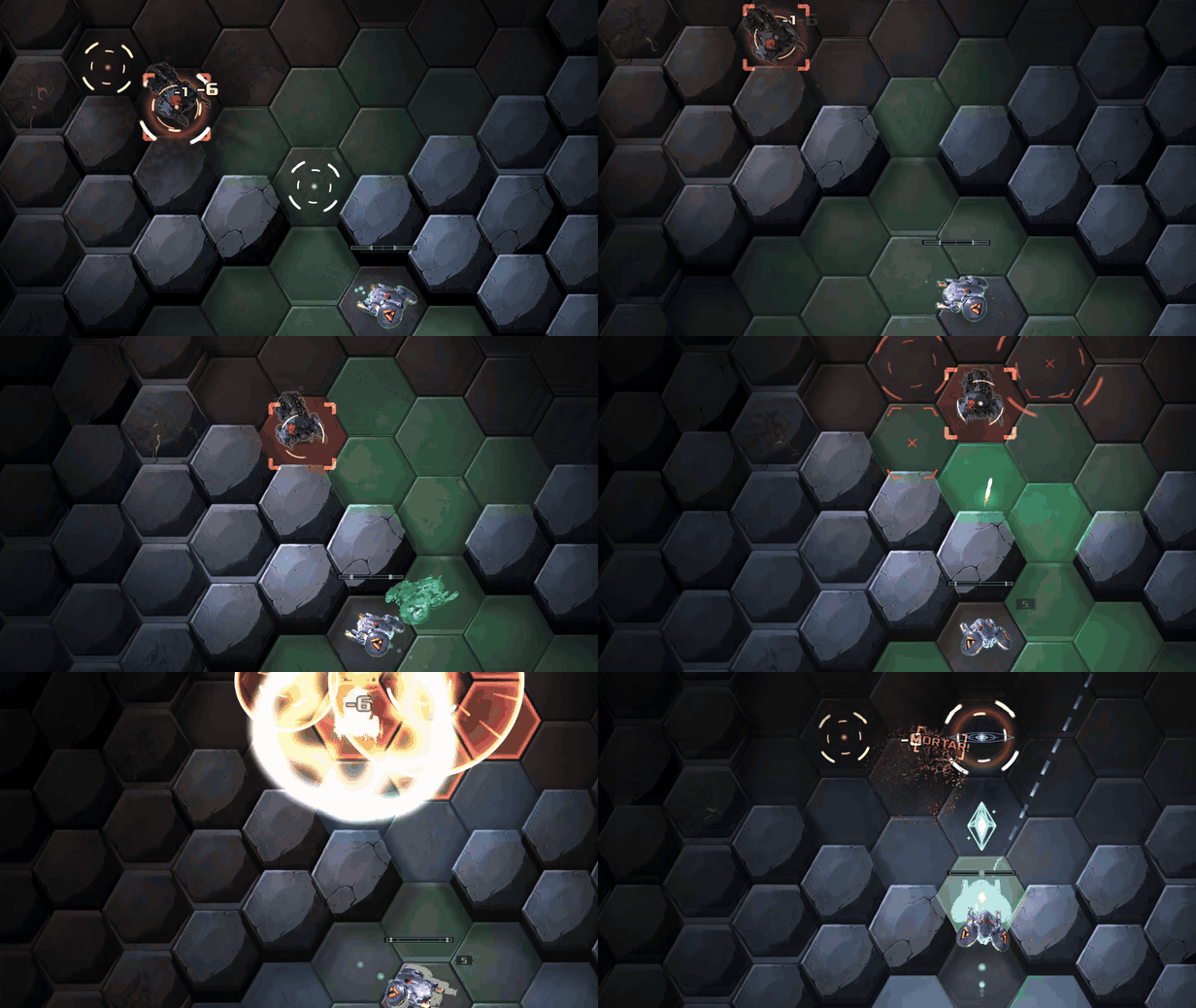
The weapon picks the part, not the aim
The idea sounded simple: wherever you hit, that's what falls off. Get behind the enemy, shoot off its engine.
In practice it doesn't work, for an embarrassingly mundane reason: enemies turn to face the player. The entry point of a shot is almost always the nose. However carefully you aim, the same part keeps coming off, and the “choice” becomes a formality.
So the part is chosen not by the aim but by the weapon class.
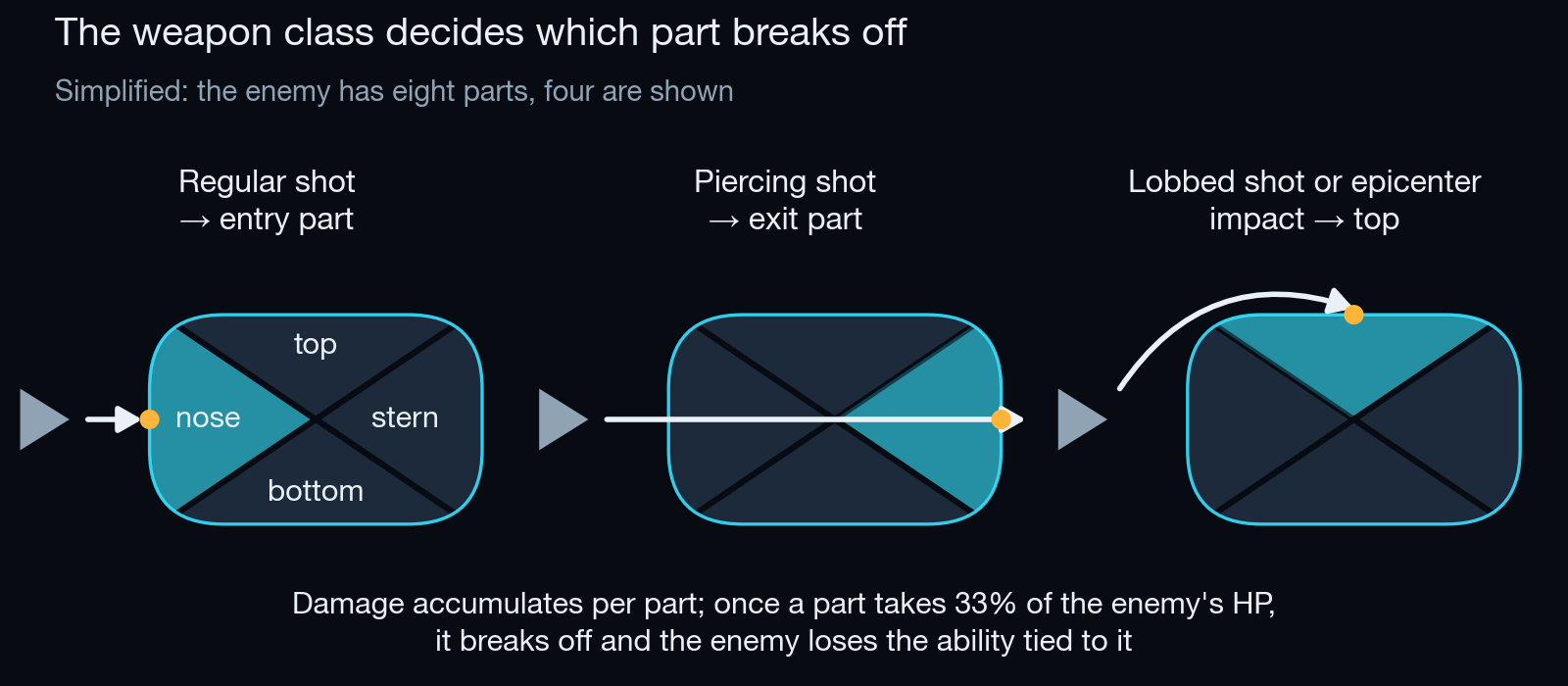
| Damage class | Which part accumulates it |
|---|---|
| Regular: kinetic, heavy, pellets, blast, thermal, shock, cryo, gravity, melee | the entry part — the one facing the player |
| Piercing (railgun) | the exit part; if there is none, the entry part |
| Lobbed shots and epicenter hits | the top part |
Damage accumulates per part role. The threshold is 33% of the enemy's maximum health: once it's reached, the most damaged intact part of that role breaks off. A burn tick, which has no direction, doesn't count.
There is a safeguard against the dull outcome where an enemy dies without losing anything: at 50% health the most damaged part breaks off if none has been lost yet, and at 25% if fewer than two have.
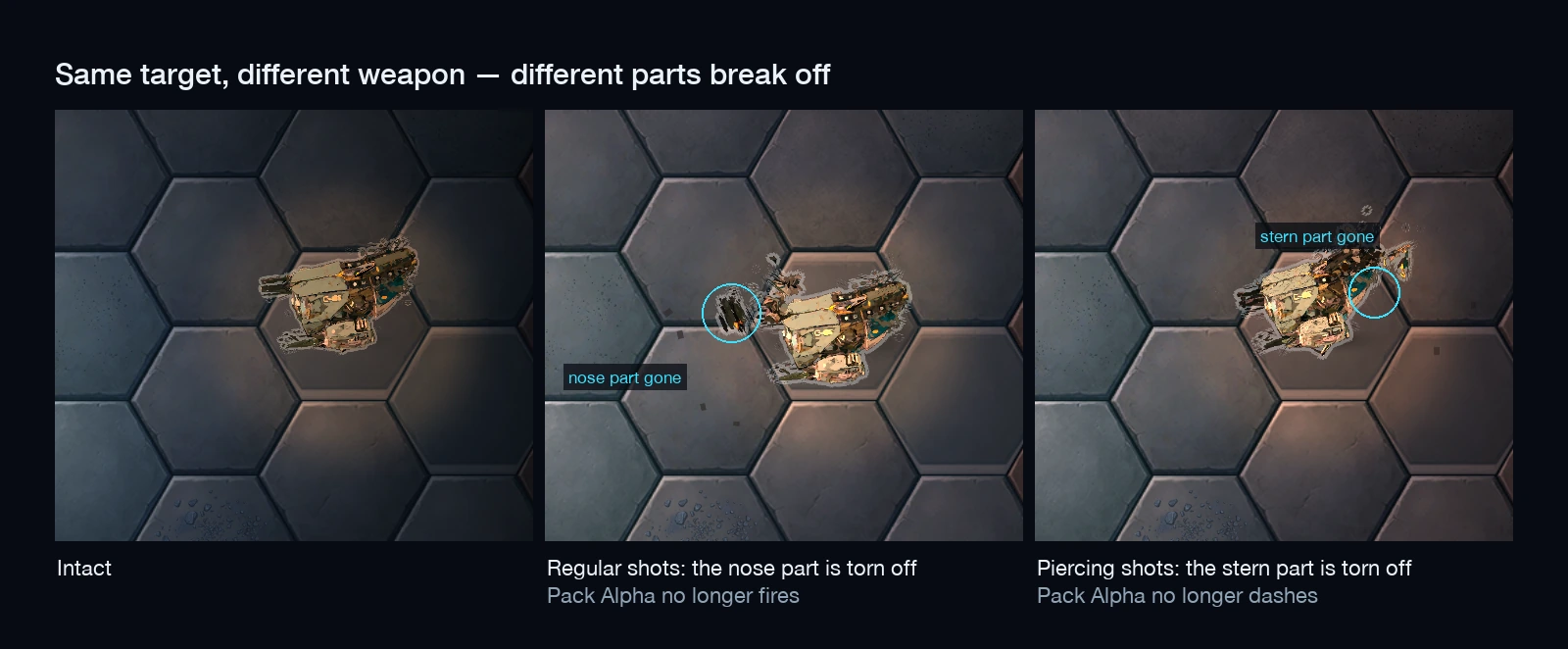
What matters is what happens after the break. At a hundred pixels a missing piece of plating is easy to overlook, so each part is tied to an ability. All seven have roles.
| Champion | Splats / chunks | Lost one part | Lost the other |
|---|---|---|---|
| Pack Alpha | 5,093 / 54 | nose — no longer fires, dashes more often | stern — no dash, turns half as fast |
| Battery | 3,440 / 36 | top — fires incendiary shells | bottom — no longer jumps |
| Bastion | 4,711 / 47 | barrel — its fire sector goes dark | — |
| The Eye | 4,979 / 55 | lens — three short beams | stern — no blink |
| Shepherd | 5,378 / 58 | emitter — overload, wards stripped | stern — no dash |
| Hive Mother | 4,565 / 46 | ring — ejects a container | turbine — assembly takes longer |
| Sower | 5,174 / 57 | sensor — shorter detection range | bay — cloak stripped |
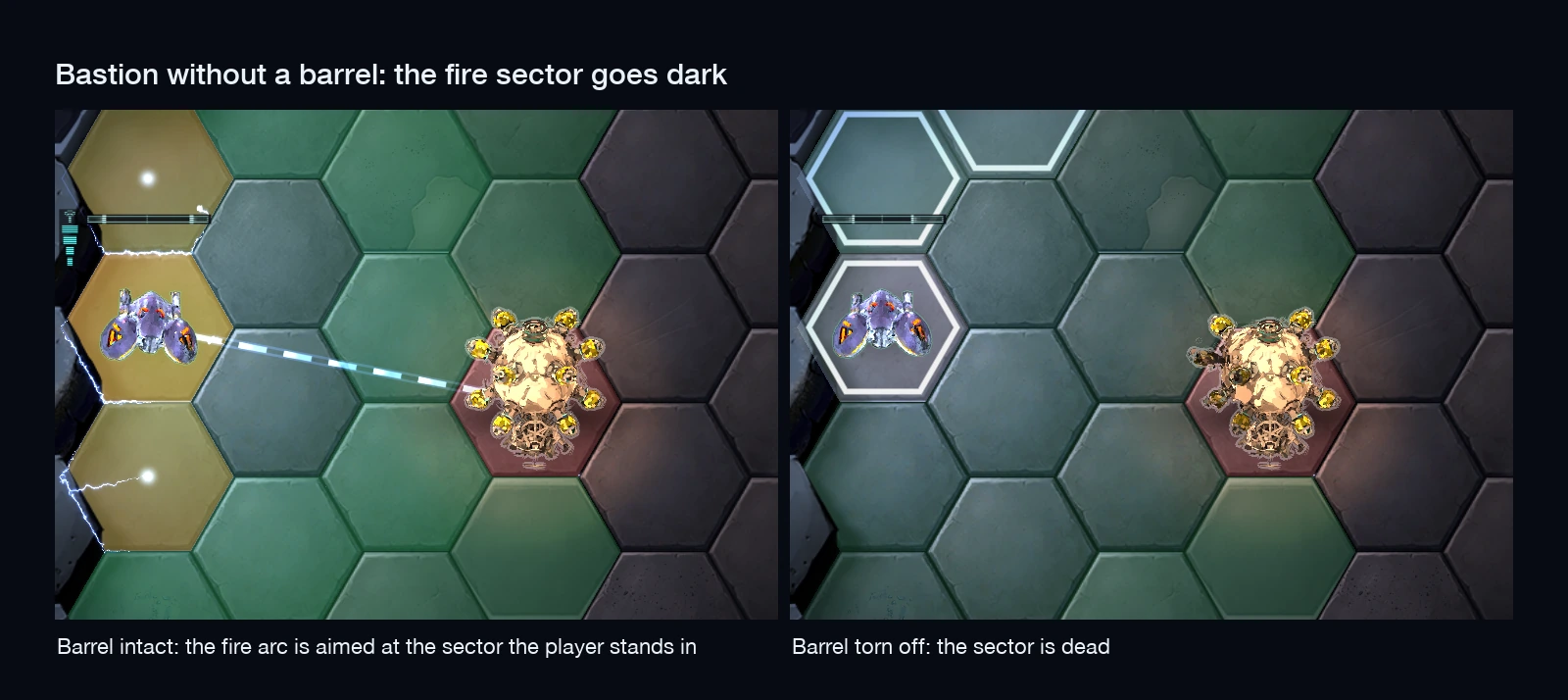
It takes on the order of five to ten hits to break a part off. I can't be more precise: I have changed champion health since the measurement.
I like the result better than the original idea. Flanking is still the player's move, but the decision is made earlier — when choosing a weapon. Take the railgun and you'll be knocking engines off pack leaders. Take the mortar and it's domes.
Bosses: the most damaged part, and inertia
Bosses had parts from the start, and at 75, 50 and 25% health one of them broke off. Which one was decided by chance. A player could spend the whole fight shooting the Crimson Skull in the face and, at the threshold, watch the back of its head fall off.
Now bosses use the same accumulator as champions, with the same table of damage classes, and at a threshold the part that took the most damage breaks off. If no per-part damage has accumulated, or several parts tie, the old rule applies.
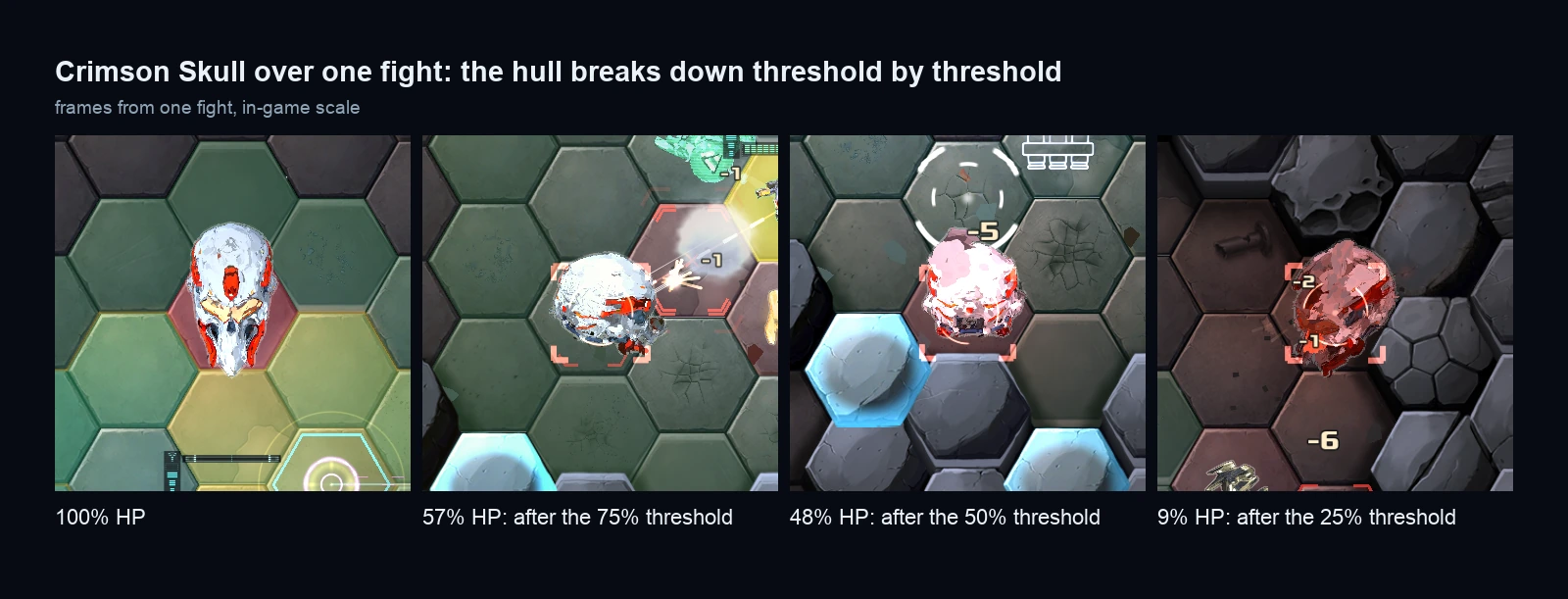
The second change is turn inertia. The boss hull used to turn toward the player quickly — the Skull covered more than three quarters of the way in a quarter of a second — and a dash to the flank bought almost nothing. Now the hull approaches its target exponentially: the fraction of the angle covered is 1 − e−k·t. The coefficient k is 2.5 for the Skull and Iron Maw, down from 6 and 4, and 4 for the Lightning Aviator, down from 10.
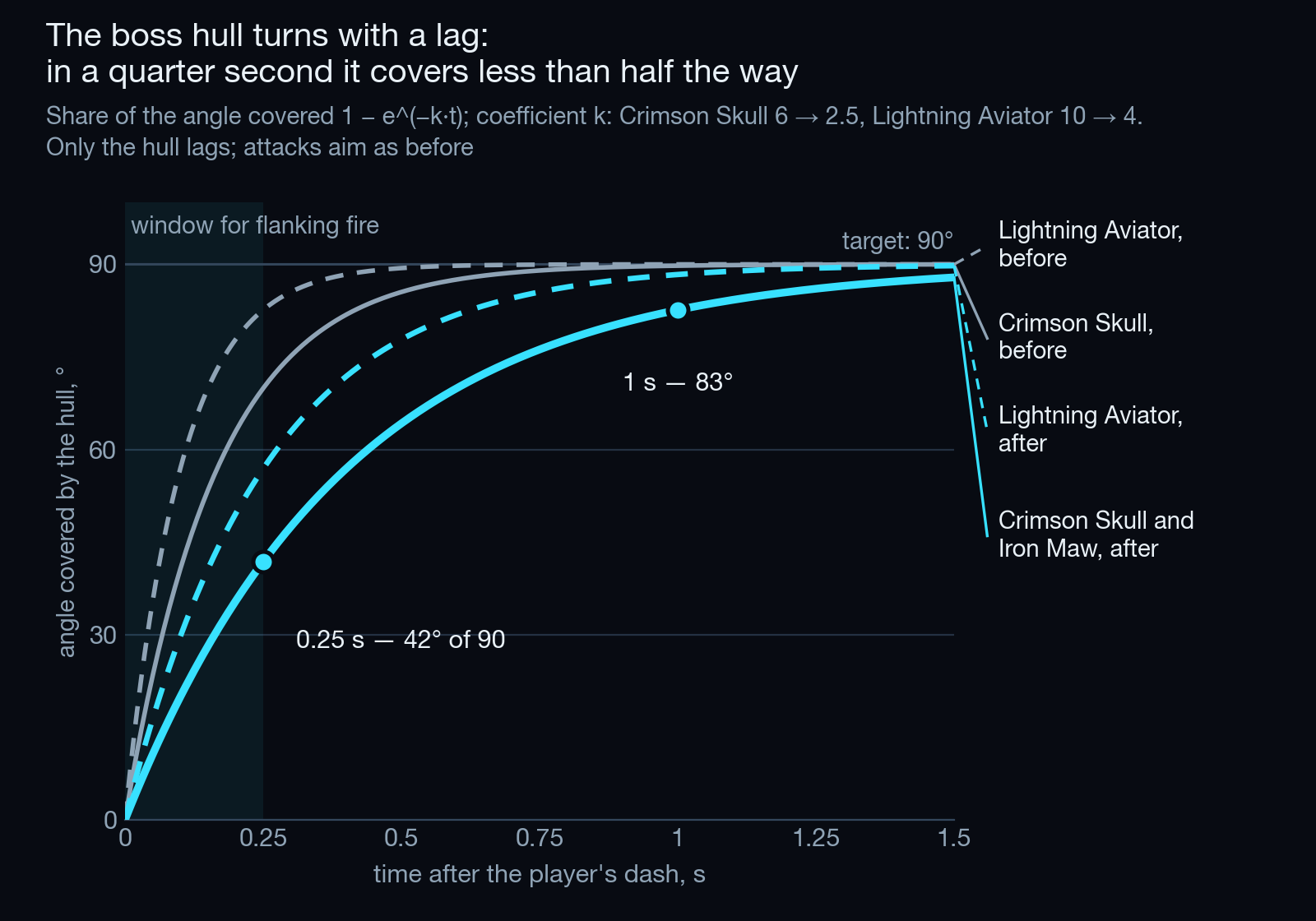
The formula gives 42° of 90 after 0.25 seconds and 83° after one second; the in-game measurement gave 42.5° and 83°. A dash to the flank buys a beat or two of fire into the side. One important detail: only the hull lags. The boss's attacks aim exactly as before, otherwise inertia would turn into free safety.
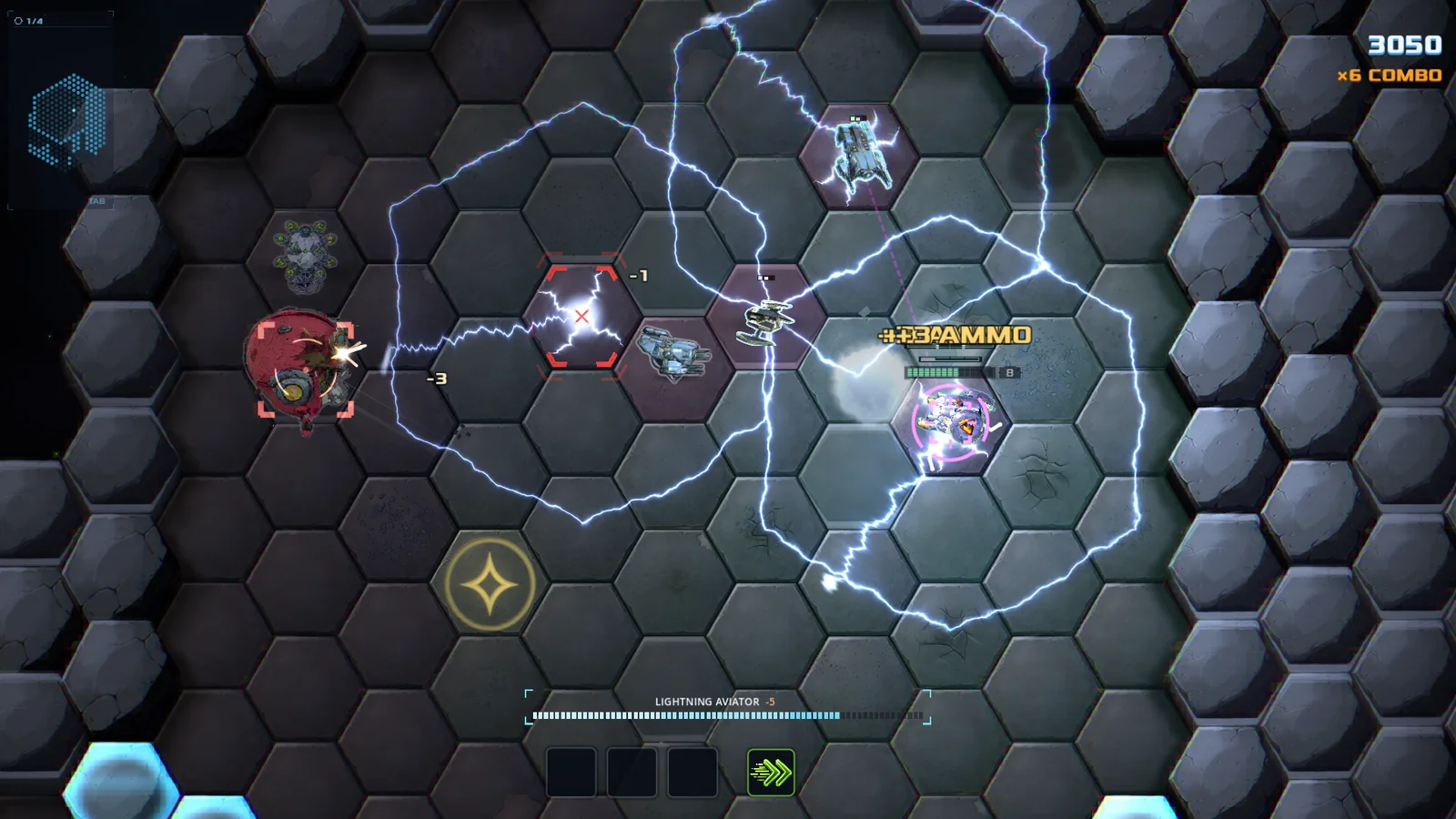
The C++ core
All the destruction mechanics from the first post — picking the hit point, the support graph, settling, tearing off a chunk, debris — were written in GDScript. About 4,700 lines of core and roughly three thousand more of glue. It worked, but the game visibly stuttered on strong beats, and I was sure I knew the culprit.
Measure first
Godot's “process” counter showed 26 ms per frame in a fight. I already had a first porting plan when I decided to check the counter itself. It turned out to show not the frame time but the maximum over a second, including the wait for vsync. One slow frame out of sixty colors the whole second. The real frame is 16.7 ms, p95 17.9.
The second discovery was worse: in a fight with the Skull the hull took 1.4% of the time. Less than one second out of sixty-five.
So porting the core for the sake of the average frame was pointless. The point was elsewhere: that 1.4% was not spread evenly across frames but landed on hits, hits land on the beat, and in a rhythm game everything else lands on the beat too — effects, sound, logic. The problem was the spikes.
Step zero: no C++
Before porting anything, I squeezed out what lay on the surface:
- in a fight I stopped recomputing soot over the whole hull after every hit — only the chipping in the touched spots and their neighbors: a hit on the Skull went from 12.1 to 7.9 ms on average, p95 from 23 to 13;
- the wave overlay on the floor was drawn as many separate polygons; a single polygon instead saved 2.5 ms in every frame.
The second item has nothing to do with splats at all. The same measurement found it.
What moved
Picking the hit point, the support graph, settling of detached islands, the chip contour, tearing off a chunk, rings, cracks, scorch marks, healing, chunk scatter and the debris pool. Twelve files, 6,049 lines, attached to Godot as a GDExtension. Decisions about what hits and where stayed in GDScript — only the arithmetic moved.
The core runs for the player's avatar (the “drone” of the first post) and for bosses. The champion hulls discussed above are still computed in GDScript: their turn hasn't come yet.
The reference and the shadow run
The most useful decision in the whole port was not to throw the old core away. The GDScript version stayed as the reference, and the game got a shadow mode: every call goes to both cores, and after every call their state is compared bit for bit.
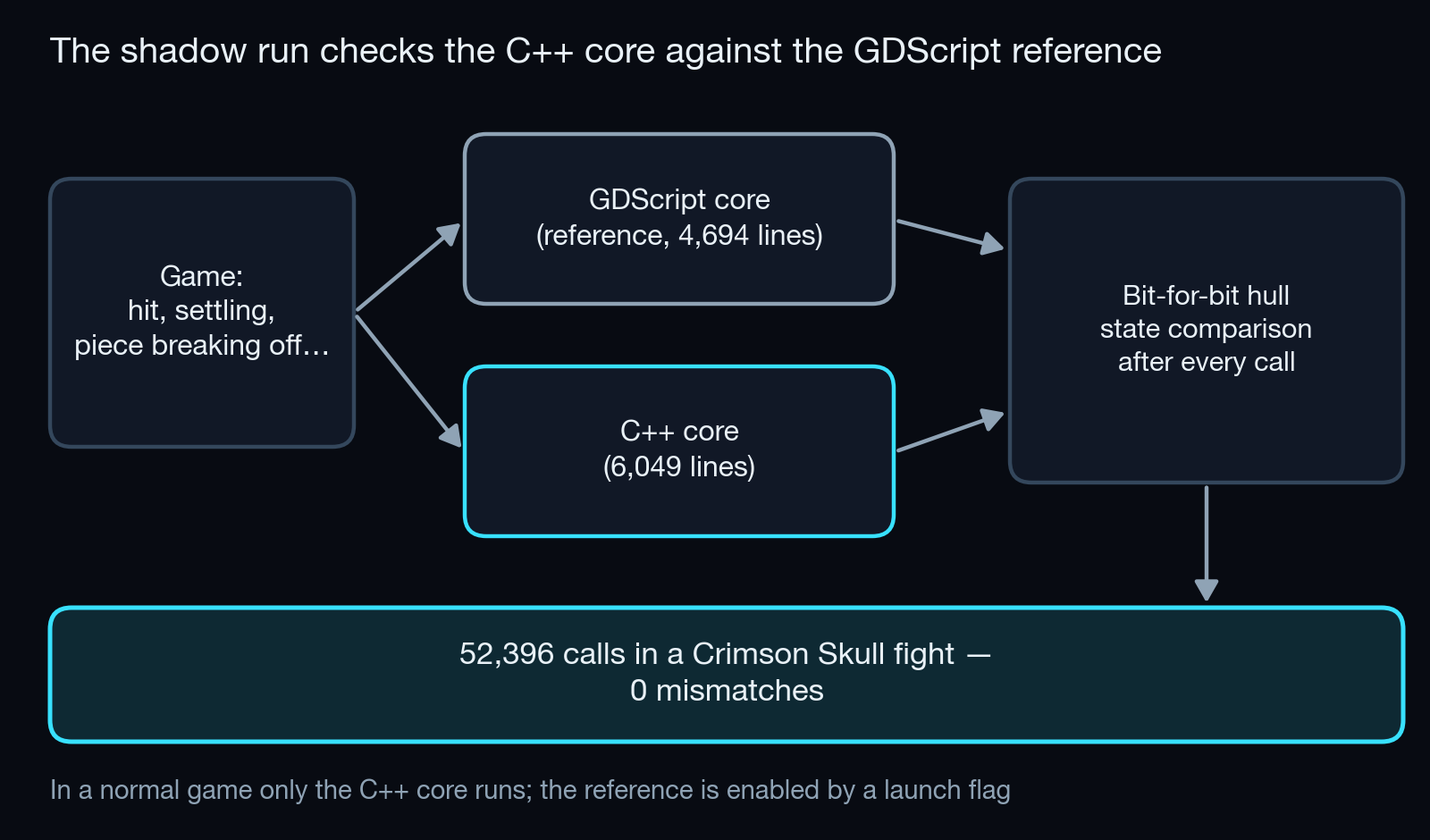
One live fight with the Skull is 52,396 calls: 23,918 for the boss and 28,478 for the avatar. Zero mismatches. Zero under Wine as well, though there I ran test stands and one fight, not a hundred.
Demanding “bit for bit” feels excessive right up to the first mismatch. After that it turns out to be the only way to tell a porting bug from “well, floating point”.
Pitfalls
Sine and cosine. Under Wine the tumbling of chunks after a tear diverged from the reference, and the shadow run caught it. The cause: the engine's Windows build is compiled with MinGW and computes trigonometry with x87 instructions, while my library took the functions from the system ucrtbase. The results differ in the last bit. The cure was my own wrappers that compute the way the engine does.
Merged calls. On macOS the compiler noticed a cos and a sin of the same angle next to each other and replaced them with a single call returning both. Its last bit is different. The merging had to be turned off.
Multiply-add. Without -ffp-contract=off the compiler fuses a·b + c into one instruction with one rounding instead of two. A dot product starts to differ from what the engine computes. I checked on twenty thousand vector pairs.
Random numbers. The old core had 157 calls to the game's shared generator. For two cores to compute the same thing they need the same random numbers in the same order — and the rest of the game needs exactly that order too. I replaced all 157 with a stateless hash: a random number is computed from what is already known at the call site and doesn't touch the shared generator. The side benefit turned out to matter more than the main one: the Daily Challenge no longer depends on how many times something got torn off the player.
Uploading to the multimesh. Computing new splat positions quickly is half the job; they still have to reach the GPU. In the end it is the whole buffer at once with a preset bounding box — 32–93 microseconds per hull.
The result
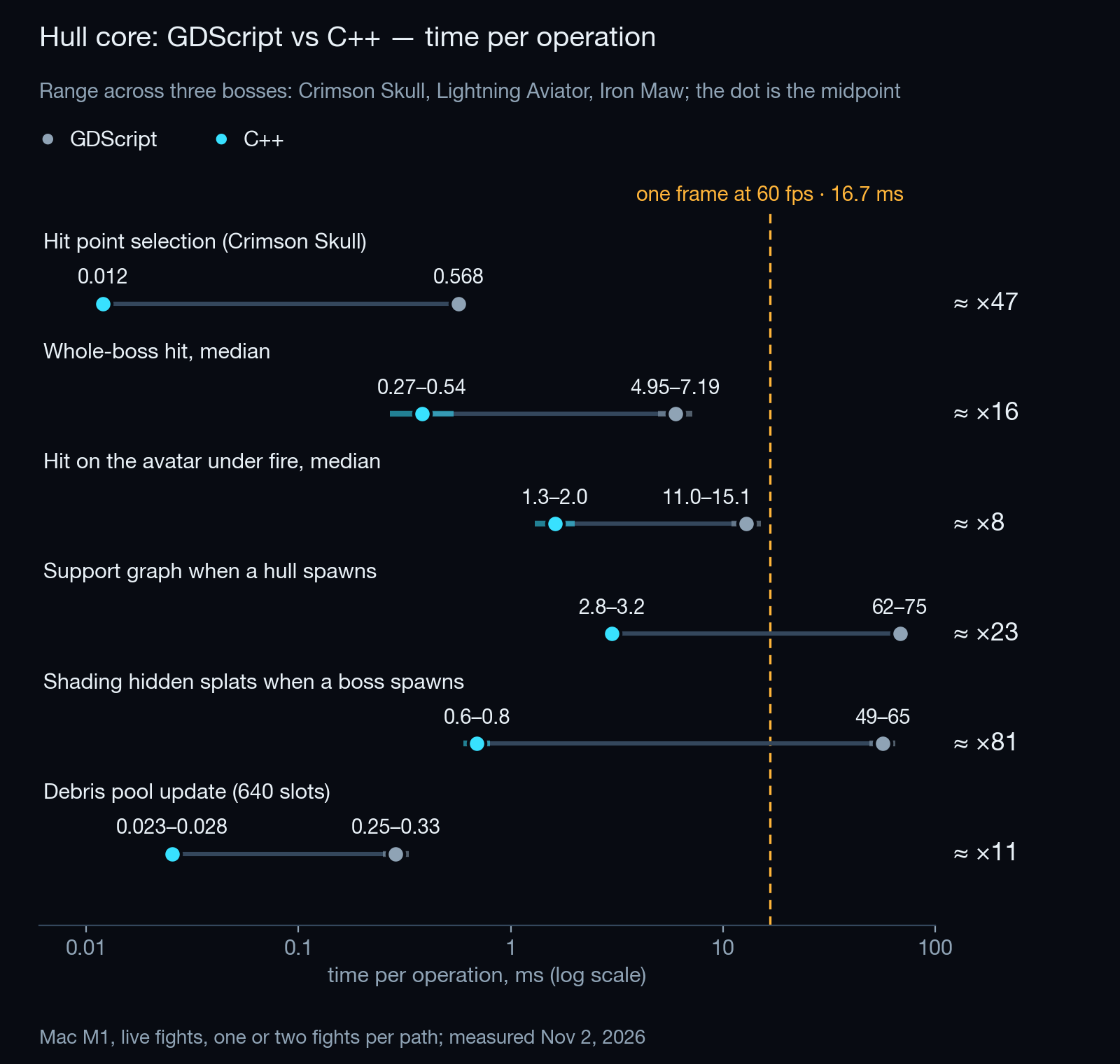
Live fights, one or two per path:
| Boss | Core | Boss hit, ms: median / p95 | Avatar hit, ms: median / p95 | Beat frame, p95, ms | Beat frames over 50 ms |
|---|---|---|---|---|---|
| Crimson Skull | GDScript | 6.86 / 14.41 | 14.88 / 24.76 | 44.4 | 3 |
| Crimson Skull | C++ | 0.47 / 0.98 | 2.03 / 2.82 | 34.5 | 0 |
| Lightning Aviator | GDScript | 4.95 / 9.09 | 11.03 / 20.20 | 59.0 | 12 |
| Lightning Aviator | C++ | 0.27 / 0.79 | 1.39 / 2.65 | 40.2 | 1 |
| Iron Maw | GDScript | 7.19 / 12.57 | 15.11 / 29.39 | 45.4 | 3 |
| Iron Maw | C++ | 0.54 / 1.27 | 1.31 / 3.13 | 25.9 | 0 |
Individual stages: picking the hit point on the Skull — 568 microseconds versus 12, about 47 times; building the support graph when a hull spawns — 62–75 ms versus 2.8–3.2; shading hidden splats when a boss spawns — 49–65 ms versus 0.6–0.8. The last two are the hitch at the moment a boss appears in the arena. In a separate, later measurement, tearing the avatar's hull with a 12 HP hit took 2.6–3.8 ms instead of 28–34.
All of these were measured on November 2–11. Since then, large torn-off chunks have started flying out into the game world and staying there; their flight is handled by GDScript, not the core, and is not part of the numbers above.
The average frame didn't change: 16.7 ms before and after. The spikes did.
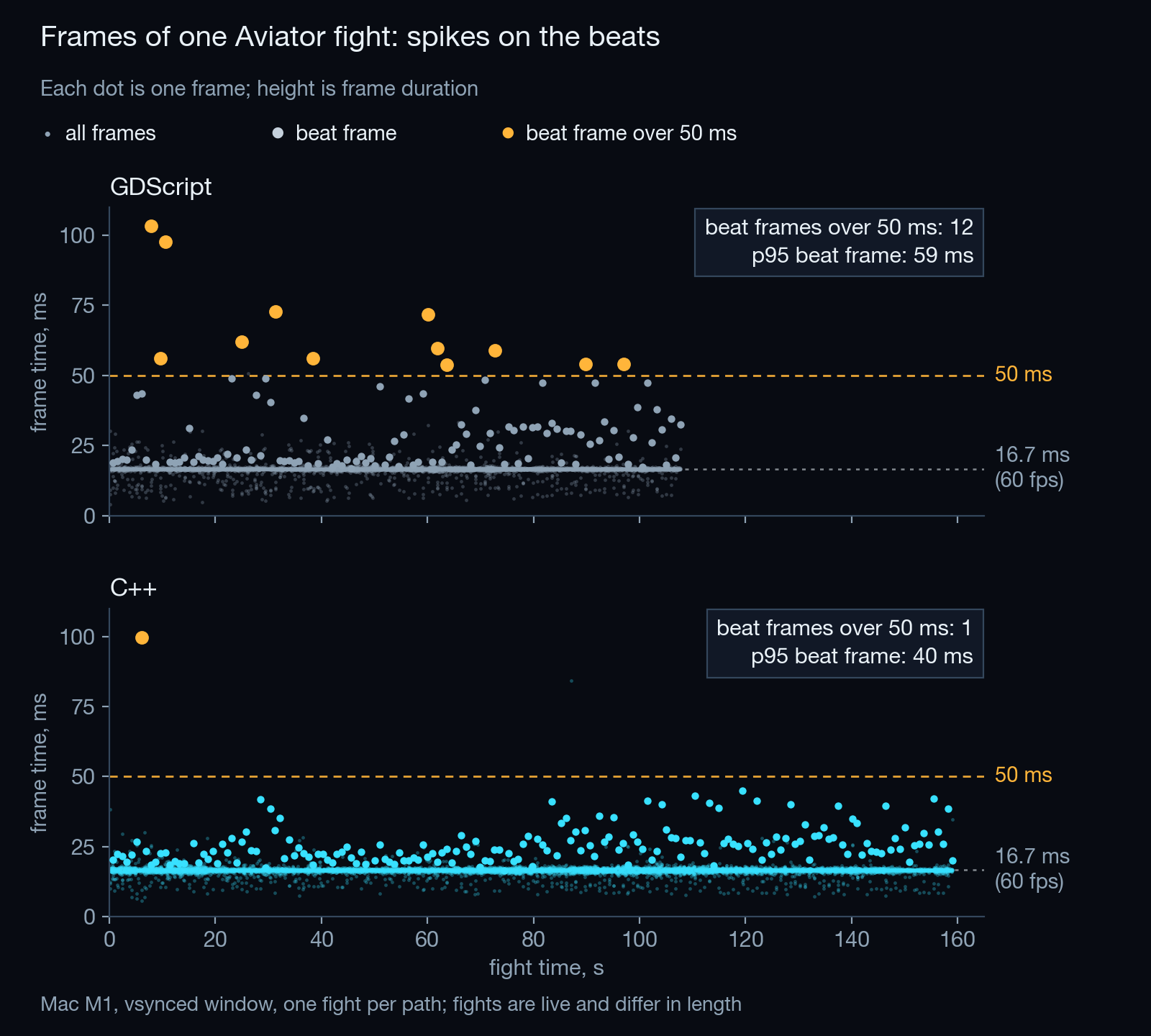
Twelve frames over 50 ms in a fight are twelve times a hit on the beat feels like a stumble. One is within the margin of error.
Safeguards
A native library in a Windows game that I build on a Mac is something worth not trusting. So:
- a watchdog: on start the core leaves a marker in the profile and removes it on a clean exit; if the marker is still there from last time, the game crashed, and the core is disabled — the game runs on GDScript;
- a launch flag that brings the old core back;
- an emergency build with no library at all;
- a self-test under Wine that I run when building;
- AddressSanitizer runs, with no findings.
The core has been on by default since November 3.
What's left
After the port, 30 to 65% of a hit's time is no longer the core but the GDScript logic around it: deciding what kind of hit this is, where it landed, what to trigger next. That is an estimate, not a measurement, but the conclusion is clear: the next millisecond is not in C++.
The hull as a health bar
Briefly, about what was a single sentence in the first post: “a dented side is a story, an HP bar is a report”.
When I measured how the avatar's hull actually loses plating, the report and the story disagreed. In October destruction counted hits, not health: by zero HP the avatar had lost only 25–30% of its plating and died almost intact.
After several passes the share of stripped plating follows health: 16.8% at three quarters, 33.0% at half, 51.3% at a quarter and 59.2% at zero. Separately, at the 70, 45 and 20% thresholds the outer sections of the hull break off.
There is no picture here, and that is an honest result: at in-game scale the avatar is about sixty pixels, and the difference between neighboring steps doesn't show in a still.
What didn't work
“Wherever you hit, that's what falls off.” Covered above: the enemy always stands nose-on. A good idea on paper, the same torn-off part in practice.
The first Pack Alpha. 2,800 splats and 128² textures — a blurry blob next to crisp meshes. The same lesson about 128² source textures as in the first post.
Automatic splat cleaning. The same filter I used on the Battery would have cut 19.5% of the Pack Alpha's splats along with the thin details of its hull. The Pack Alpha stayed uncleaned.
A cheap GPU for training. Covered above: Pascal can't run the kernels I need.
A light on an enemy. Eight extra milliseconds on p95 from a single source — a reminder that splats stopped being the most expensive thing in my frame a while ago.
Part destruction in a still frame. For this post I tried to shoot, through the game camera, a Battery without its bottom part and the avatar's hull at different health steps. It didn't work: for those two the loss doesn't show in a still at in-game scale. That is not a failure of the mechanic — it is exactly why losing a part changes the enemy's behavior and not just its look — but it is a useful cold shower for someone used to looking at his models on a test stand.
Porting for the average frame. Had I not checked the counter, I would have ported the very same core, got the very same 16.7 ms, and spent a long time looking for where the gain went.
What Next Fest told me about the tech
Destruction in games has interested me for a long time — but not the voxel kind. When I learned about Gaussian splats, I decided to see what would come of it. First there were test stands; then a game grew out of the stands.
So for me the game is also a test of an idea: do splats work as destructible assets, and does anyone besides me find that interesting? I count the response in two columns: players, and people who came for the technology.
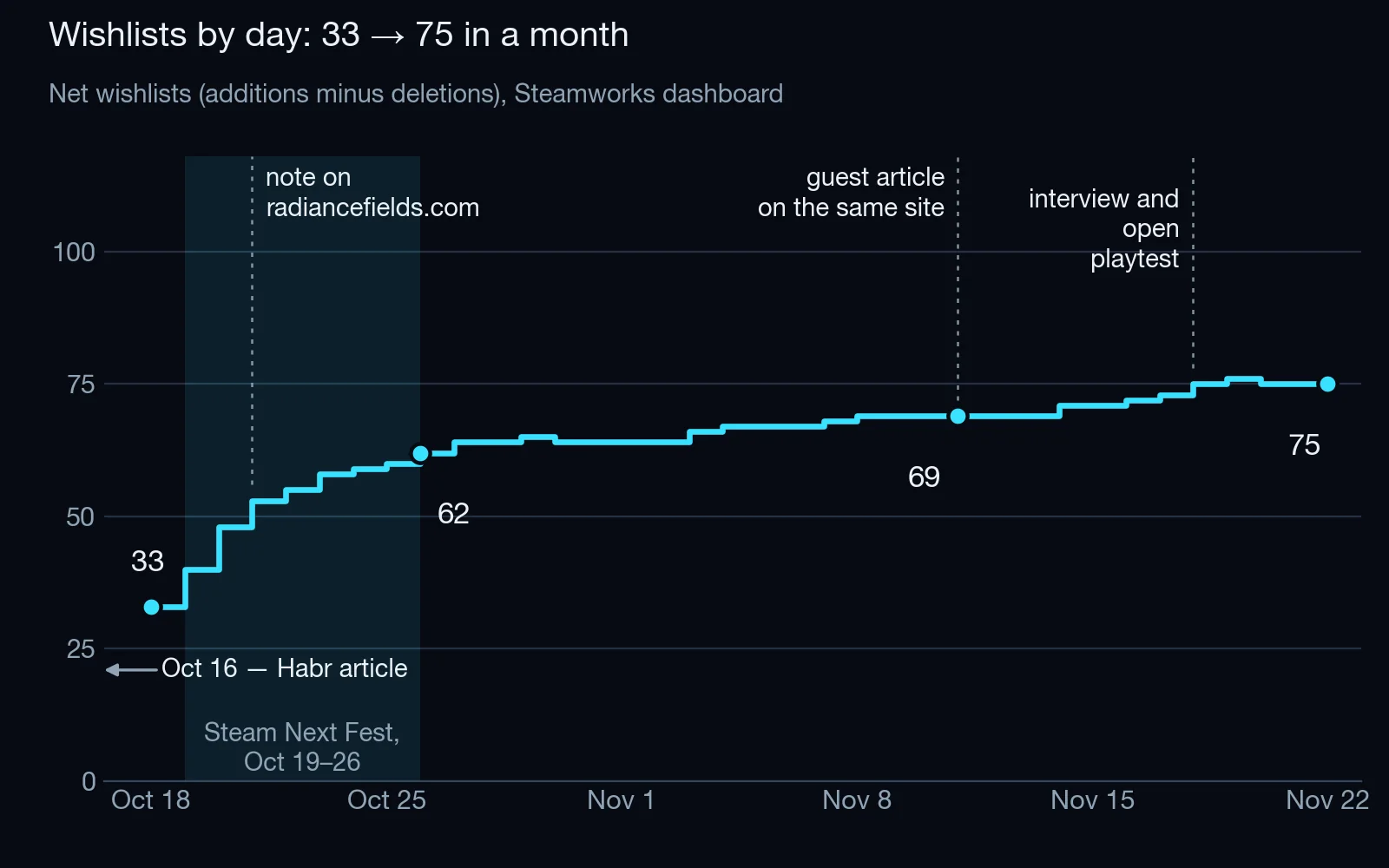
| Wishlists | 33 before the fest → 62 after it (+33, −4) → 75 a month later; +10 in the eight days before the fest |
|---|---|
| Store page, fest week (Oct 19–26) | 26,969 impressions, 1,673 visits |
| — from the fest section | 26,131 impressions → 237 visits (0.91%) |
| — from direct search by name | 508 impressions → 249 visits |
| Demo | 930 licenses, 37 people launched it (4%) |
| First technical article (in Russian) | 894 reads, 9 bookmarks, 0 comments |
| Tagged links, fest week | 211 visits to Steam, 3 wishlists |
| Day of the guest article and the day after | 69 wishlists → 69 |
More people searched for the game by name than the fest section brought in. The editors of radiancefields.com, a site about splats and radiance fields, wrote a note about the game and then published my guest article; an interview came out as well.
The conclusion is not the one I was hoping for. Technical write-ups get read, and a specialist outlet took the material — for me that is the answer “yes, it's interesting”. But it barely turns into wishlists: a reader of a post about splats comes for the splats, not for a roguelite. The wishlists came from the fest — that is, from players who don't care what a boss is made of.
If you are building a game around a technology and hoping that posts about the technology will sell it, I have one month of data for you, and it says “no”. Posts give you something else: reads, bookmarks and a place on a specialist site.
Summary
| Champions | 7 kinds, 3 with a pack per run, at most 3 splat hulls in a room |
|---|---|
| Splats per champion hull | 3,440–5,378 |
| Cost of a hull per frame | ≈ 1 ms; 0.16 ms per thousand splats |
| Parts per hull | 8, computed at export (3 hand-labelled on the Hive Mother) |
| Part break threshold | 33% of the enemy's health per part role |
| C++ core | 12 files, 6,049 lines; GDScript reference — 4,694 lines |
| Cross-check of the two cores | 52,396 calls in a fight, 0 mismatches |
| Boss hit, median | 4.95–7.19 ms → 0.27–0.54 ms |
| Beat frames over 50 ms per fight | 3 / 12 / 3 → 0 / 1 / 0 |
| Average frame | 16.7 ms before and after |
| Wishlists | 33 → 62 over the fest → 75 a month later |
What I would do differently:
- Check the counter before writing the plan. The first porting plan was built on a number that meant something else.
- Set up the reference and the bit-for-bit check on day one, and make random numbers stateless right away. Half of the porting pitfalls were a hunt for a mismatch that a shadow run finds in a single fight.
- Test a rule against how the enemy actually stands. “Wherever you hit” died not in the code but in the very first fight.
- Look at everything at in-game scale. That was on the list last time too. Apparently this lesson takes three tries.
You can play for free: the AsterMaster demo on Steam, release in January 2027. The site with the same splats in the browser is aster-master.com.
Transparency: as disclosed on the Steam page, some promo art and item icons, a few source 3D meshes, the background music and some flavor text were made with generative-AI tools and curated by me; nothing is generated at runtime. The splat pipeline, the destruction rules and the C++ core described here are my own work, with a significant part of the code written in pair with an AI coding agent (Claude Code). The decisions, the taste and the runs are mine; we share the blame for the pitfalls.
If you have questions about GDExtension, about bit-for-bit checking of two implementations, or about how to make a point cloud lose its nose separately from its stern — write to info@aster-master.com.
— zakons, solo dev of AsterMaster
AsterMaster — a beat-driven roguelite shooter on a hex grid. Free demo out now · full release in January 2027.
Play the free demo Wishlist on Steam